 May 23, 2018
Evaluating the Scalability of Different Combined Cycles with Bottoming sCO2 Turbines

Update – March 1, 2023: AxCYCLE is our legacy software depreciated by AxSTREAM System Simulation. System Simulation was born out of the union of the legacy AxCYCLE and AxSTREAM NET software packages.
Bottoming cycles are generating a real interest in a world where resources are becoming scarcer and the environmental footprint of power plants is becoming more controlled. With this in mind, reduction of flue gas temperature, power generation boost, and even production of heat for cogeneration application is very attractive and it becomes necessary to quantify how much can really be extracted from a simple cycle to be converted to a combined configuration.
Supercritical CO2 is becoming an ideal working fluid primarily due to two factors. First, turbomachines are being designed to be significantly more compact. Second, the fluid operates at a high thermal efficiency in the cycles. These two factors create an increased interest in its various applications. Evaluating the option of combined gas and supercritical CO2 cycles for different gas turbine sizes, gas turbine exhaust gas temperatures and configurations of bottoming cycle type becomes an essential step toward creating guidelines for the question, “how much more can I get with what I have?”
Using conceptual design tools for the cycle system generates fast and reliable results to draw this type of conclusion. There are both qualitative and quantitative advantages of combined cycles for scalability using machines ranging from small to several hundred MW gas turbines to determine which configuration of sCO2 bottoming cycles is best for pure electricity production.
The bottoming sCO2 cycle makes it possible to utilize residual heat from the gas turbine unit (GTU)’s exhaust, producing additional energy and improving the overall efficiency of the system. It is evident that different types of bottoming sCO2 cycles have a different ability of heat utilization and its conversion into electricity. In addition, a sCO2 cycle may have a high efficiency of heat-to-electricity conversion but may have a small temperature difference at the heater that significantly limits the GTU exhaust gases heat utilization degree. I.e., a high efficient bottoming sCO2 cycle may give less of an electricity production addition to the whole system when compared to one with moderate efficiency but with higher sCO2 temperature difference at the heater.
Below are examples of three configurations of bottoming sCO2 cycles for exhaust heat recovery from an existing GTU, including the simple recuperated cycle, the pre-compression cycle, and recompression cycle, as shown in figures 1, 2 and 3. This kind of study is performed with SoftInWay’s heat balance calculation tool AxCYCLETM. sCO2 properties are obtained from the NIST database.
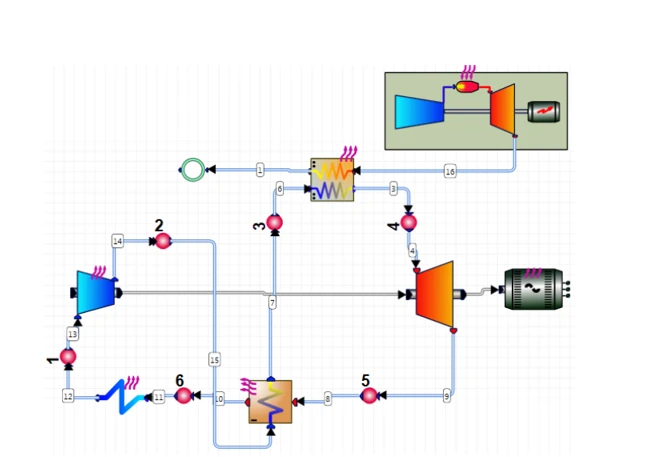
Figure 1: GTU with bottoming recuperated sCO2 cycle
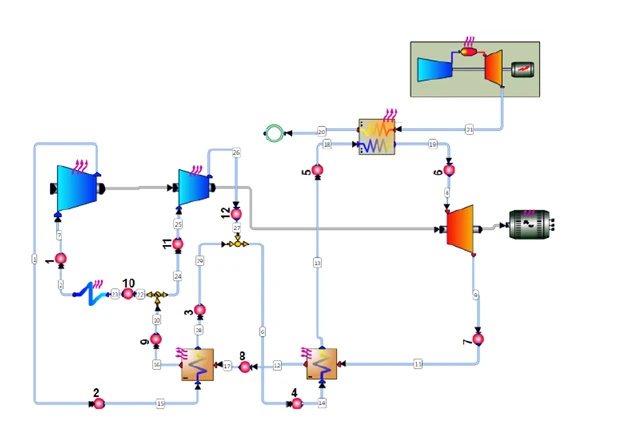
Figure 2. GTU with bottoming recompression sCO2 cycle
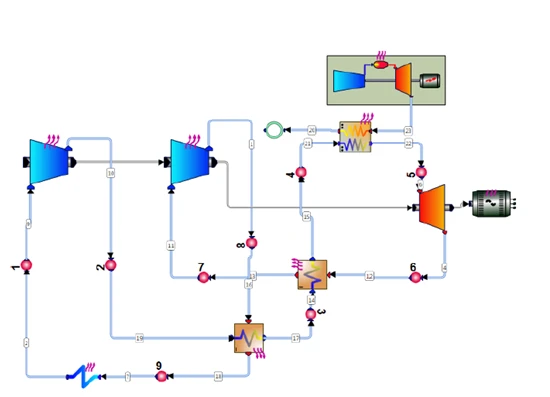
Figure 3. GTU with bottoming pre-compression sCO2 cycle
Efficiencies under different operating conditions like turbine inlet temperature, flue gas mass flow rate, and etc. can be obtained as seen in Figure 4.
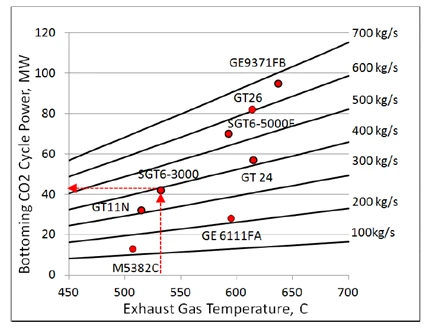
Figure 4. Bottoming sCO2 cycle power generation potential
If you are interested in learning how to select and standardize your sCO2 cycle configuration with AxCYCLE, please contact info@softinway.com for a demonstration or follow the link!
"*" indicates required fields
![Fig. 2. External appearance of the turbopump unit (TPU) of a RD0120 engine [3]](https://www.www-softinway-com-dead8c31.faststaging.dev/wp-content/uploads/2025/04/TPFig2.jpg)
![Figure 3: Direct-to-Chip Liquid Cooling Configuration [3]](https://www.www-softinway-com-dead8c31.faststaging.dev/wp-content/uploads/2025/04/DC-Fig-3.png)